
Interpretations in Good Faith? A Persistent Challenge in the Nuclear Age
On February 24, 2026, a sense of urgency was conveyed by UN Secretary-General António Guterres as he called for an immediate end to the nuclear arms race. In Guterres’ own words, investments in “the architecture of peace, not the tools of war,” are necessary for global peace to prevail. This assertion calls into question the very nature of international security among states, for only through collective action can a true end to the arms race be achieved. Guterres’ statement holds considerable weight in the face of nuclear weapons, where the risk of large-scale casualties and global destruction emphasizes the necessity of an end to the expansion of nuclear arms. Indeed, the protection of international humanitarian law (IHL) rests on the legal premise of non-proliferation, which refers to the end of the spread and development of nuclear weapons and disarmament commitments.
The question then becomes: is IHL at risk of dissolution in the face of nuclear deterrence? When considering this, two important lines of thought arise, putting into question not only the interpretation of international treaties, but compliance with the treaties themselves. In other words, how are states required to follow legally binding international agreements?
IHL, sometimes called the “laws of war,” govern how armed conflicts are conducted. One of its core functions is protecting people not actively participating in combat, including wounded and sick soldiers, medical personnel, prisoners of war, and civilians. Crucially, IHL only comes into force during armed conflict. Unlike international human rights law, which applies to governments at all times, IHL has no role during peacetime — it is a framework designed specifically for the realities of war.
The majority of IHL is codified in the four Geneva Conventions of 1949, with the fourth Convention explicitly addressing the protection of civilians during armed conflict. The binding character of the Convention is concretely stated in Article I, which commits all signatory states (High Contracting Parties) to uphold and respect the established provisions “in all circumstances.” As Mirjana Spoljaric, the president of the International Committee of the Red Cross (ICRC), stated at the UN Security Council in 2025, the international community is currently facing “not only a crisis of compliance with the rules of war, but one of collective conscience.”
Compliance, however, goes beyond formal acknowledgement. For states to effectively fulfill their obligations, they must interpret the conventions according to principles of good faith, meaning the interpretation of the treaty must reflect its true intentions and preserve its broader purpose as stated.
Although adopted before the Vienna Convention on the Law of Treaties (VCLT) (1969), the Geneva Conventions can be interpreted relative to the VCLT, which, under Article 31, further emphasizes that all treaties be interpreted in good faith. The ICJ reiterated this in its 1996 Advisory Opinion on the Legality of the Threat or Use of Nuclear Weapons, in which the court concluded the obligation of states to pursue nuclear disarmament according to principles of good faith. Although advisory opinions are not legally binding, they do offer clarification regarding state obligations under treaty commitments. In this case, the ICJ reaffirmed that good faith interpretation of IHL is an expected and necessary standard of state conduct. This means that in their pursuit of nuclear disarmament, all signatory states must act with humanitarian considerations at the forefront, respecting the “spirit” of the Geneva Conventions. Critically, states must interpret the Geneva Conventions to prioritize the protection of human life—the foundational pillar of IHL.
Not only is good faith inherent to interpretations of IHL, but it also remains a critical component of nuclear non-proliferation treaties. The Treaty on the Non-Proliferation of Nuclear Weapons (NPT) entered into force in 1970 with one of its objectives being the disarmament of nuclear weapon states (NWS). NWS are those officially recognized as possessing a nuclear arsenal by the NPT. The NPT contains an explicit condition of good faith. Stated in Article VI, all negotiations towards nuclear disarmament must be carried out in good faith — meaning all negotiations must respect the fundamental and original objective of the treaty. By no means should any signatory state attempt to evade the provisions put forth, particularly not when such provisions ensure the protection of human life.
Nuclear deterrence poses the primary threat to the protection of IHL by violating the fundamental principles of the convention. Strategies that comprise the further development and expansion of nuclear arsenals place civilians at high risk of mass casualty and large-scale devastation. Beyond this, deterrence undermines the foundation of disarmament, whose objective is the elimination of nuclear weapons, not their entrenchment as a security strategy. Honouring the NPT in preservation of IHL ultimately calls for effective disarmament, which would necessarily end the need for deterrence. Without a persistent threat of nuclear confrontation, states would no longer have an incentive to develop their nuclear arsenal in retaliation. This is, of course, much easier said than done.
The position of states outside of the NPT, notably India, Israel, Pakistan, South Sudan, and North Korea, promotes the existing inclination of NWS to curtail their disarmament efforts. Without the established safeguard measures by the International Atomic Energy Agency (IAEA), NWS outside of the treaty are not compelled to adhere to the same standards of transparency as NPT signatory states. This increases the overall sense of global insecurity, leading to the desertion of disarmament efforts by NWS and jeopardizing good faith compliance with IHL and the NPT.
External challenges are not the sole aspect hindering true compliance with the NPT. While a large number of states have joined the treaty, including five nuclear-weapon states—the United States, Russia, China, France and the United Kingdom—the nature of the treaty itself poses a challenge to the effective pursuit of disarmament in good faith. In practice, these five NWS fail to commit to reducing their nuclear arsenals, instead maintaining deterrence strategies, leaving non-nuclear states witness to the open disregard for disarmament efforts.
The tenth NPT Review Conference, held in New York in 2022, illustrated this asymmetry clearly. NWS advocated for a continued reliance on nuclear weapons amid increasingly unstable international security conditions, while the increased urgency of nuclear disarmament commitments was emphasized by non-nuclear states.
The United States and Russia’s failure to renew New START this February, a bilateral treaty placing a limit on each country’s nuclear arsenal, is the clearest example of NWS broader neglect of their disarmament obligations under the NPT. Article 26 of the Vienna Convention declares that States which have ratified an international treaty are not only thereby bound by its terms, but must also pursue it in good faith. New START, which was brought into effect on February 5, 2011, enforced mutual limits on American and Russian “strategic offensive arms,” including a ceiling of 1,550 deployed nuclear warheads. Although this treaty did not address disarmament directly, it provided a strong bilateral agreement to reduce the further development of nuclear arsenals. Its expiration not only poses a risk for future nuclear proliferation, but veers both nuclear weapon states farther from disarmament, a necessary measure towards the fulfillment of obligations under the NPT.
Interpretations of international treaties in good faith appear to be at risk of dissolution as prominent NWS recede from disarmament efforts. While most nuclear weapon states remain signatories of the NPT, their efforts to effectively carry out disarmament are failing, undermining the very purpose of both international humanitarian law and nuclear non-proliferation. The collective conscience of the international community rests on the necessary commitment to good faith principles. To genuinely invest in the architecture of peace, NWS must treat nuclear disarmament not as an aspirational footnote to their treaty commitments, but as the urgent, concrete obligation it has always been.
Edited by Sofia Gobin
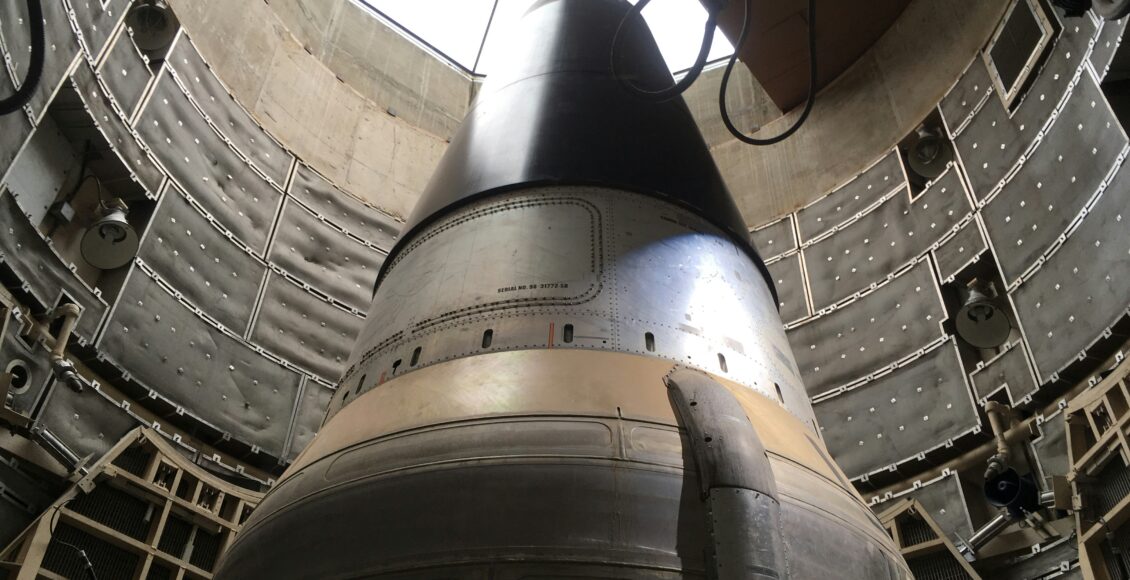
Featured Image: Decommissioned nuclear missile at the Tittle Missile Museum, Green Valley, Sahuarita, Arizona. Photo by Stephen Cobb is licensed under Unsplash.
