
The Slow Death of the WTO
In the early 2000s, a relatively obscure trade dispute over Vietnamese fish exports illustrated how the global trading system worked. Vietnamese producers of pangasius, often marketed in the United States as catfish, faced anti-dumping tariffs after American industry groups argued that imports were being sold at unfairly low prices. Vietnam rejected this claim, framing the measures as protectionist, turning to the World Trade Organization (WTO) to challenge the US. At the time, this was not unusual: the WTO’s dispute settlement system allowed smaller economies to contest the policies of far larger trading partners, with the expectation that rulings would be binding and enforceable.
That system rested on a two-tier structure. Panels issued initial rulings, and the Appellate Body—which is effectively the WTO’s highest court—reviewed them to ensure consistency and legal finality. For decades, this mechanism gave the rules-based trading order its credibility. In fact, the Appellate Body was often referred to as the “jewel in the crown” of the WTO. States could lose cases, but they could not easily avoid complying with adverse rulings, as non-compliance exposed them to authorized retaliatory tariffs. That equilibrium began to unravel in the late 2010s. Beginning under the Obama administration and continuing through the Trump presidency, the United States blocked the appointment of new Appellate Body judges. This was not entirely a partisan move: both Democrats and Republicans increasingly viewed the court as overreaching its mandate, particularly in ways that constrained US domestic policy. By December 2019, the Appellate Body no longer had enough judges to hear appeals, and the final stage of WTO dispute settlement effectively collapsed.
Today, the system operates in a legal limbo. Countries bring disputes, and panels can still issue rulings. Losing parties can appeal those rulings “into the void,” where they remain indefinitely suspended. The result is a system that formally exists, but no longer compels compliance in the way it once did. The United States remains the central actor in this crisis. Its continued refusal to approve new judges reflects a deeper skepticism toward binding international adjudication, one which cuts across party lines and reflects broader anxieties about sovereignty, industrial policy, and strategic competition.
China and other emerging economies have been among the most vocal critics of Washington’s position, arguing that the paralysis undermines the credibility of global trade rules. For them, the dispute settlement system was one of the few arenas where legal process could offset power asymmetries. Middle powers, including Canada and the European Union, have tried to preserve elements of the system, but their efforts have had a limited reach. Many developing countries find themselves in increasingly precarious positions. Without a functioning appellate mechanism, the ability to challenge trade restrictions imposed by larger economies becomes far less meaningful. The kind of case Vietnam once brought may be possible in theory, but it is less actionable in practice.

Recent developments suggest that this is not a temporary disruption but a structural shift. Since 2019, negotiations to restore the Appellate Body have made little progress, largely because the underlying disagreements remain unresolved. At the same time, governments have become more willing to pursue trade policy unilaterally: tariffs, subsidies, and national security justifications have become more prominent tools of economic statecraft. While disputes continue to be filed at the WTO, the lack of enforceability reduces the incentive to comply with its rulings.
More broadly, the role of the WTO itself appears to be changing. Rather than serving as a robust enforcement mechanism, it is increasingly functioning as a forum for monitoring trade policies and facilitating negotiations. This is not necessarily a formal transformation with treaties in place, but it has been developing in practice. Many trade policy experts see this evolution as a reflection of deeper geopolitical tensions, particularly between the United States and China. These tensions are not simply about trade balances or tariffs; they are rooted in structural competition over technology, supply chains, and global influence. The United States has grown wary of a system that, in its view, fails to adequately account for state-led economic models such as China’s. China, for its part, has benefited from the predictability of WTO rules, which have provided stable access to foreign markets, constrained the use of arbitrary trade barriers, and allowed Chinese firms to plan, invest, and export strategies with a reasonable degree of certainty. The result is a fundamental disagreement over what the trading system should do and who it should constrain.
Some analysts remain cautiously optimistic that reform is possible. They argue that a modified appellate system could emerge if major powers agree on clearer limits to judicial authority. Others are more skeptical, suggesting that the WTO may evolve into a looser, more fragmented institution in which enforcement is partial and regional arrangements play a larger role. In this view, the era of a fully binding, universal dispute settlement system may be over. For smaller economies, the stakes are particularly high. Without a credible mechanism to enforce trade rules, they are exposed to protectionist measures and economic coercion. The shift from a rules-based system to a more power-based one does not happen overnight, but its effects can be cumulative and difficult to reverse.
One possibility is adaptation. The WTO could find a new role as a forum for transparency, dialogue, and coordination, even if binding enforcement remains limited. Another may be fragmentation, where regional agreements increasingly define the contours of global trade. Neither outcome fully replicates the system that once allowed a country like Vietnam to challenge US trade policy on equal footing. The pangasius dispute can now be looked at as a glimpse of a fading order. It captured a moment when legal rules, rather than raw power, structured global trade relations. Whether that model can be restored, or whether it has already been replaced, remains one of the defining questions of the contemporary international economy.
Edited by Eliot Mudry Danisch
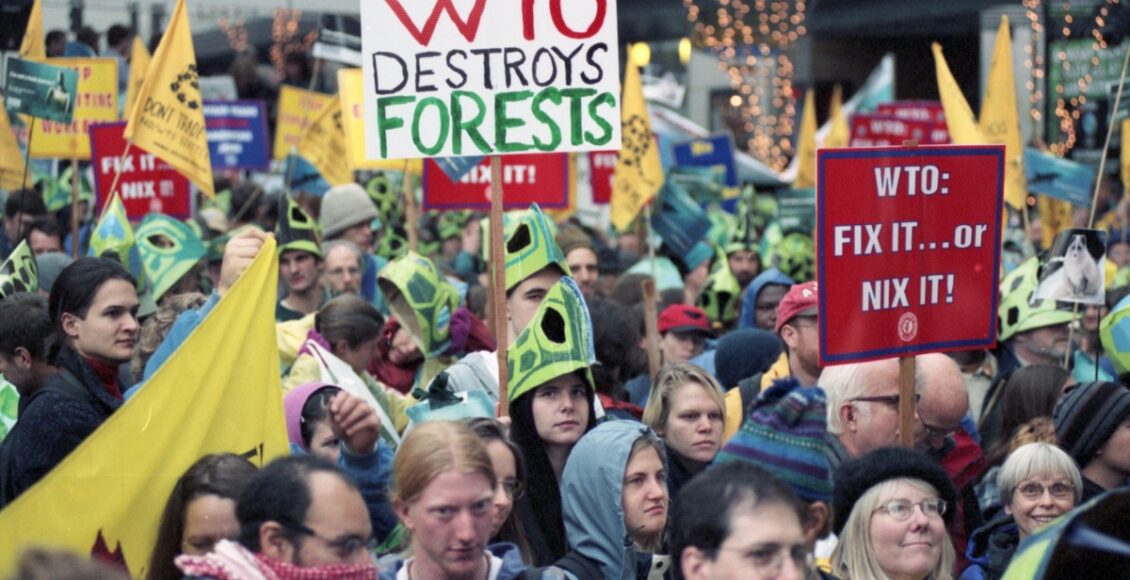
Featured Image: Anti-WTO protestors in Seattle, 1999. Photo by Seattle Municipal Archives, is licensed under CC BY 2.0.

