
Erling Haaland and the Privatization of Soft Power

On a typical weekend, millions of viewers across every continent tune in to watch Erling Haaland play football. His goals are replayed within seconds on TikTok, Instagram, and YouTube; his images appear in advertisements, sports promotions, and global news headlines; and people from Montreal to Oslo proudly wear jerseys with his name. Searches for his name increased by 900 per cent during the tournaments compared to last year. Few Norwegian politicians, or even Norway’s broader political institutions, could hope to command a comparable level of international attention. Yet despite becoming one of Norway’s most recognizable figures, Haaland is not a diplomat, nor has his global influence been facilitated by the Norwegian government. Instead, his international impact and visibility came almost entirely through football clubs, multinational corporations that collaborate with football committees, digital platforms, and other private parties, such as his own personal brand.
This raises an important question: who produces soft power in the twenty-first century?
Soft power was first conceptualized in 1990. Scholars have generally understood it as a state’s ability to influence others through attraction rather than coercion or economic inducement. Countries exercise soft power when others admire their culture, political values, institutions, or foreign policy, making cooperation more likely without the use of force. For decades, governments have sought to facilitate this attraction through public diplomacy, investing in cultural exchanges, international broadcasting, educational programs, and global events to shape how foreign publics perceive them.
However, the social context in which this theory was developed has changed dramatically. Digital platforms have fragmented information flows; many multinational, privately owned corporations now have audiences larger than those of some national broadcasters; and celebrity figures often enjoy greater global recognition than political leaders, as the public prioritizes entertainment over serious political discussions. This transformation can be described as the emergence of a network society, in which communication is increasingly organized through decentralized digital networks rather than hierarchical institutions. In such an environment, influence no longer belongs exclusively to governments. Instead, corporations, athletes, entertainers, influencers, and social media platforms have become powerful producers of international attraction in their own right.
Among these different actors, elite athletes offer particularly revealing case studies. Football has become one of the world’s most globalized industries, generating audiences measured in billions through international broadcasting, sponsorships, gaming franchises, and social media systems. Players are no longer simply representatives of their clubs or national teams; they have become transnational brands whose influence frequently extends beyond the states from which they originate. Erling Haaland represents a compelling example of the privatization of soft power. He is particularly valuable as a case study because his worldwide influence remains closely associated with Norway, even though he is not tied to government institutions. By examining Haaland’s rise, we can see that soft power has not disappeared in the digital era. Rather, it has become increasingly decentralized, commercialized, and privatized. As states lose control over how soft power is created, public diplomacy may need to focus less on building national narratives and more on responding to narratives created by private actors.

Haaland’s international visibility emerges from an ecosystem of institutions that operate largely beyond the Norwegian state. Manchester City, the Premier League, UEFA, Nike, EA Sports, social media platforms, sports broadcasters, and millions of online users all contribute to producing Haaland’s global visibility. They also produce many of the same outcomes traditionally associated with soft power: attraction, familiarity, admiration, and emotional attachment.
The mechanism of Haaland’s impact is institutional amplification. Unlike traditional public diplomacy, which relies on embassies, Haaland’s visibility is produced through commercial organizations. The Premier League reaches nearly 900 million homes across 189 countries, while the UEFA Champions League attracts hundreds of millions of viewers each season. Every match, highlight reel, sponsorship campaign, and interview expands Haaland’s international profile.
Digital platforms reinforce this mechanism. Communication power increasingly resides in decentralized networks, and it is worth highlighting users’ roles in creating and circulating content. Haaland’s influence is sustained not only by professional media but also by millions of fans who share highlights, create memes, and participate in discussions. This participatory system gives his public image a level of authenticity that state-led campaigns often struggle to achieve. Credibility is a central source of soft power, and Haaland’s reputation is rooted in his football performance rather than political involvement.
If soft power is increasingly produced by private actors, then governments must rethink the assumptions underlying public diplomacy. Traditionally, public diplomacy has been thought to be exclusively state-directed. These efforts presume that governments can actively shape how foreign audiences perceive their country. The digital age has weakened this assumption. This does not mean governments have become irrelevant. It simply means that their role is changing. Rather than acting as the sole producers of soft power, governments increasingly become participants in a broader system of influence. Their challenge is less about constructing national narratives than understanding, responding to, and, where appropriate, collaborating with influential private actors whose global reach often exceeds that of official institutions.
Several countries have already adapted to this reality. South Korea’s global reputation has been significantly enhanced by the international success of K-pop and Korean cinema. These developments are driven primarily by private entertainment companies, though later supported by government initiatives. Likewise, Hollywood’s global appeal has contributed to American soft power despite being largely market-driven. These examples suggest that, for government authorities in the twenty-first century, effective public diplomacy may depend less on controlling narratives and more on creating conditions in which private actors can strengthen a country’s international visibility.
The privatization of soft power also creates a problem for states: influence that governments do not produce is influence they cannot fully control. The same independence that gives athletes and celebrities credibility can make them unpredictable representatives of national identity. A private actor may become internationally associated with a country while holding values, making statements, or entering into commercial relationships in ways that are undesired and not preferred by government authorities.
This creates what might be called a problem of misalignment. A government may benefit from the international admiration generated by a successful athlete, but it cannot determine how that athlete behaves. Personal controversies, political statements, disputes, or reputational crises can therefore become indirectly associated with the country itself. The relationship between private influence and national reputation is consequently asymmetric: states may benefit from private actors without possessing the authority to manage the risks those actors create.
Commercialization introduces another limitation. Haaland’s global visibility is not primarily generated by private institutions seeking to promote Norway. It exists because football, broadcasting, and digital engagement are profitable. Corporate incentives may occasionally reinforce a country’s diplomatic interests, but there is no guarantee that the two will remain aligned at all times. Private soft power is therefore powerful precisely because it is relatively autonomous from the state, but that autonomy also makes it unstable and difficult to direct.
Privatization should not simply be understood as governments losing power to more effective private actors. Instead, states are becoming dependent on sources of international attraction over which they exercise only limited control. The central challenge for public diplomacy is therefore how to engage with it without assuming that private actors can function as unofficial “diplomats.”
Haaland is not a diplomat, nor does he seek to represent Norway abroad. Yet through football, sponsorships, and social media, he has become one of the country’s most recognizable global figures. His case illustrates a broader shift in the generation of soft power, from one centred on states to one driven by private actors operating across transnational networks. Recognizing this transformation does not diminish the importance of public diplomacy; instead, it requires rethinking its purpose. In this day and age, governments must accept that they are no longer the sole authors of their national image. Their task is increasingly to engage with, rather than control, the diverse private actors who now shape how nations are perceived around the world.
Edited by Maisie Minnick
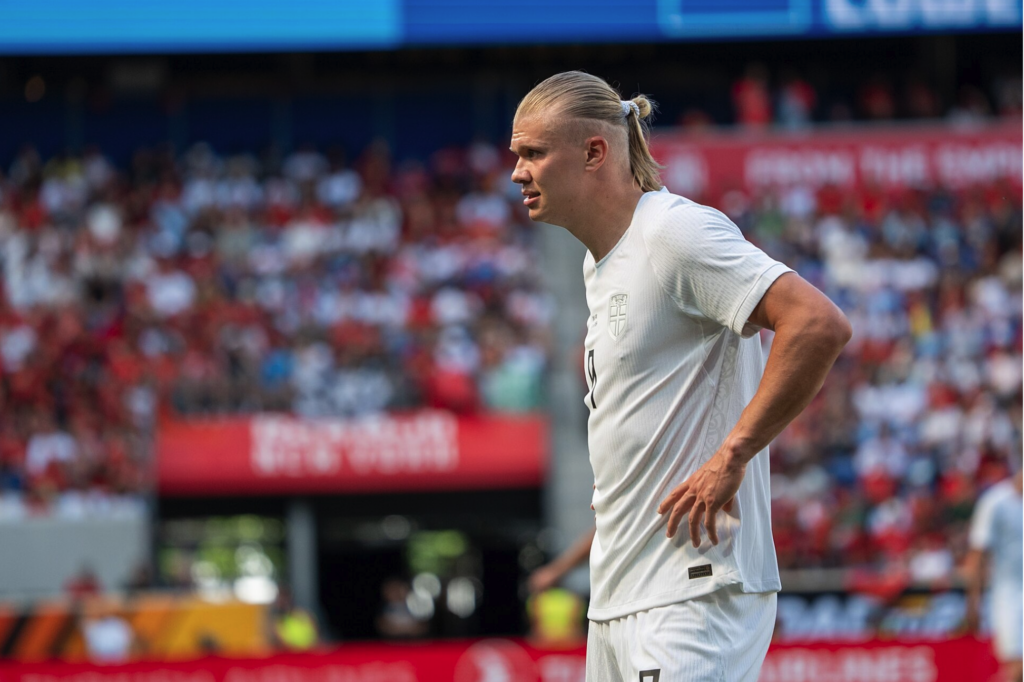
Featured Image: Erling Haaland after Norway 3 – Italy 0, World Cup 2026 Qualification. Photo by Michael Emilio is licensed under CC BY 4.0.


