
Opinion | Cowering Tiger, Sunken Dena: The American Strike and Indian Frailty
Flaunting one’s strength is easy, proving it is rarely as simple; India is in need of a sore reminder. The International Fleet Review, hosted alongside the MILAN naval exercise, was intended to be a painless assertion of Indian influence within the Indian Ocean. Over 50 countries strong in attendance, the congregation was eagerly anticipated. While leaving the event, an Iranian Moudge-class frigate—IRIS Dena—was sunk by America’s USS Charlotte in international waters, on March 7. As absurd as it is to be robbed at the police station, it’s difficult to say something about the police—India—when tethered to the Indian Ocean’s floor, 35 kilometres off Sri Lanka’s coast.
Rather than express anything substantive about the US Navy’s action, New Delhi limited itself to a narrow, humanitarian search-and-rescue mission, stressing that the ship was attacked outside of Indian jurisdiction. India’s muted response to the sinking of IRIS Dena is not a one-off instance of deference, but a long-overlooked deterioration in the country’s moral firmness. To some eyes, the country’s inability to stand resolute marks a sort of surrender of both its moral compass and its strategic claim to the Indian Ocean—not measured restraint.
India’s stylization in the global arena has consistently been that of a rising power. Part of a regional power’s charge is to posture. India should have scrutinized the act promptly and clearly, particularly since it occurred in proximate waters. Consider China’s sharp rebukes of Philippine incursions in the South China Sea, or Turkey’s condemnations of Black Sea attacks in its Exclusive Economic Zone—there is no dearth of local hegemons cautioning against political transgressions, irrespective of whether territorial jurisdiction was actually theirs to claim.
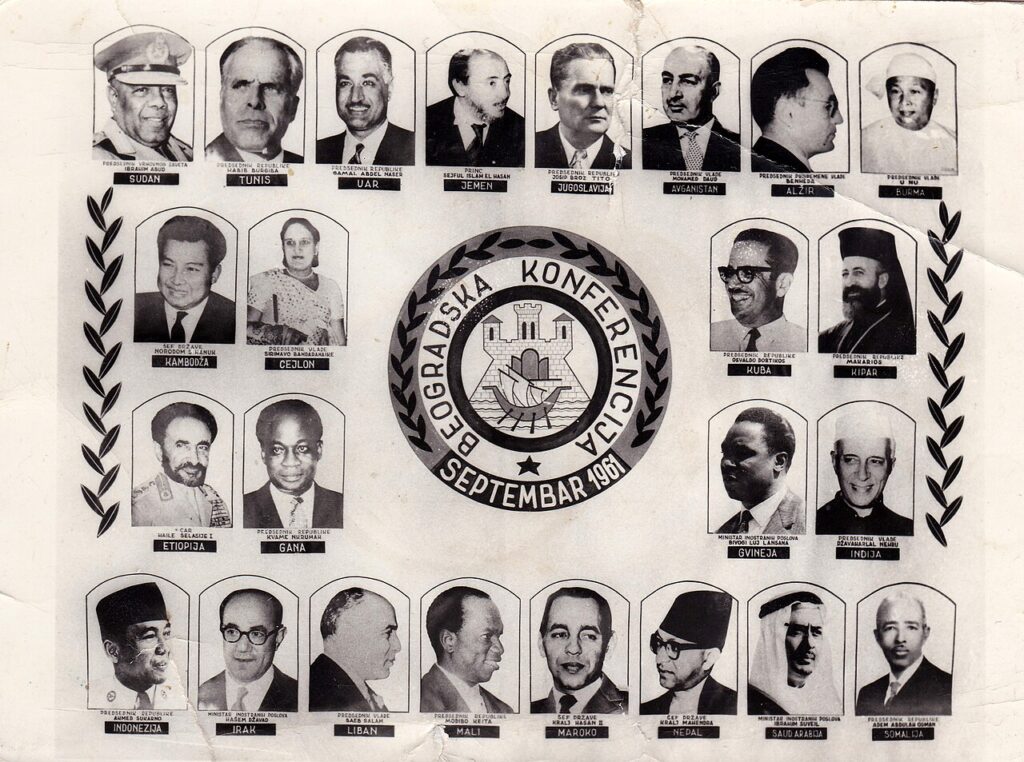
Neutrality, pacifism, strategic autonomy—Indian scholars and diplomats are well-acquainted with opaque verbiage. In the country’s nascence, however, these words were explicit. Moral fortitude at the helm of the Non-Aligned Movement (NAM) was a clear rejection of the Cold War era’s great power rivalry; such is the legacy that India helped charter. This principled neutrality has since eroded into abstentionism, with India now abstaining on 20+ UN votes since 2022 amid Russia-Ukraine and Israel-Gaza tensions.
Alliance politics critically temper international conduct. India’s forbearance towards Israel, Russia, and America is not coincidental; it is a clear function of extensive economic and defence interreliance. At the same time, India’s ties to Iran are equally complex. On one hand, Iran is a notable member of the Islamic bloc, regularly siding with Pakistan on key political disputes such as Kashmir. Conversely, Iran’s strategic value to India for energy and overland access cannot be overstated. That Iran chose to participate in the MILAN 2026 as a guest this year itself speaks volumes—note that China and Pakistan were not in attendance. The recent release of two Indian LPG-bearing tankers through the Strait of Hormuz is not without meaning either.
The pragmatism of strategic neutrality may appear sensible, but it is worth little if utterly devoid of thoughtful intervention. New Delhi clearly seeks authority, and chronic fencesitting will not grasp at even its quietest manifestations. In its self-professed adherence to neutrality, India has repeatedly shown the world where it stands. Neutrality is never apolitical; there is little strategic autonomy to be found in yielding to America.
An Indian National Security Strategy is non-existent, and the tenets of non-alignment lack codification. Without an unyielding ideological throughline, the attainment of non-alignment principles varies with the particularities of each incumbent. With IRIS Dena, it is clear what today’s India makes of “strategic autonomy”: New Delhi fears American punishment more than it values its own moral standing.
Moral reliability is a necessity for powerful states. A potential criticism from India could have focused on Sri Lanka’s territorial integrity without necessarily endorsing Iran; championing international norms is merely one of several ways to denounce the strike. India’s disorganized but vocal defences of the rules-based order would have only validated a public disavowal. If India deemed it prudent to offer Dena docking rights at the war’s outset, surely it would have been equally prudent to contest the unjust attack that led to the ship’s devastation.

That said, posturing is futile without ability. IRIS Dena’s sinking throws India’s technical capacity to police the Indian Ocean into sharp relief. A US submarine operating that close to Indian territory suggests either tacit Indian consent or a lack of detection capacity—the former a detriment to sovereignty, and the latter a detriment to maritime capability. India’s naval reach lags behind its ambitions; its self-presentation as a “net security provider” in the region is poorly founded.
Could India have detected USS Charlotte without prior knowledge? The Indian Navy fields major platforms crucial to the conduct of antisubmarine warfare (ASW): the Arihant-class ballistic missile submarines, aircraft carriers Vikrant and Vikramaditya, and importantly, the P‑8I surveillance aircraft. Despite being an indispensable pillar of the Indian Navy’s ASW arsenal, the P-8I aircraft is manufactured exclusively by the American firm Boeing. While India can credibly assemble general-purpose platforms, it has been slow to wean itself off foreign suppliers for critical maritime capabilities. India’s own defence producers are unrivalled in their perpetuation of multi-year procurement delays for major capital investments. Key modernization projects—including Air Independent Propulsion systems that would greatly enhance underwater endurance for submarines—continue to languish in the bureaucratic lethargy of the Defence Research and Development Organization.
India’s naval force projection—however formidable for a “rising power”—remains bound by significant doctrinal and budgetary constraints. New Delhi’s prioritization of Kashmir means that its navy is the most malnourished of the tri-services. Of a 2026-27 defence budget approximating $85 billion, the Indian Navy captures a measly 11 per cent. India’s geography demands intentional deep-water investments: deficiencies in air and surface assets, nuclear-powered submarines, and sensor networks will only permit adversarial forays into the Arabian Sea to proceed undetected.
Despite India being the most viable counterweight to burgeoning Chinese influence in the Indo-Pacific, its capabilities trail behind those of China, America, and Russia. The United States may be a friend, but it is not a peer. India’s ability to gauge American presence in the Indian Ocean is a litmus test of its ability to detect Chinese equivalents. Tomorrow, when it is a Chinese submarine in proximate waters instead, India will be incapable of enforcing maritime deterrence.
Trump 2.0’s foreign policy might be a relatively recent source of disorder, but India’s deference is a product of systemic neglect spanning administrations: America’s own garbled Indo-Pacific strategy has only obscured India’s role in the region. The South Asian behemoth has silently ceded its credibility to America, for the latter to uphold or dismantle at its whim; Indian neutrality has long been compromised.
Today, India’s strategic autonomy is all but autonomous. When senior naval officers dismiss the Dena tragedy as being ill-fated, the normative stagnation swaddling Indian leadership is pitifully revealed. For America, a key partner, to operate with such impunity indelibly wounds both India’s image and its power projection across the region. No singular country ought to exert such leverage over India’s posture in the Indian Ocean. Even a paper tiger is robbed of its feigned strength if riddled with visible holes.
Edited by Georgia Massis
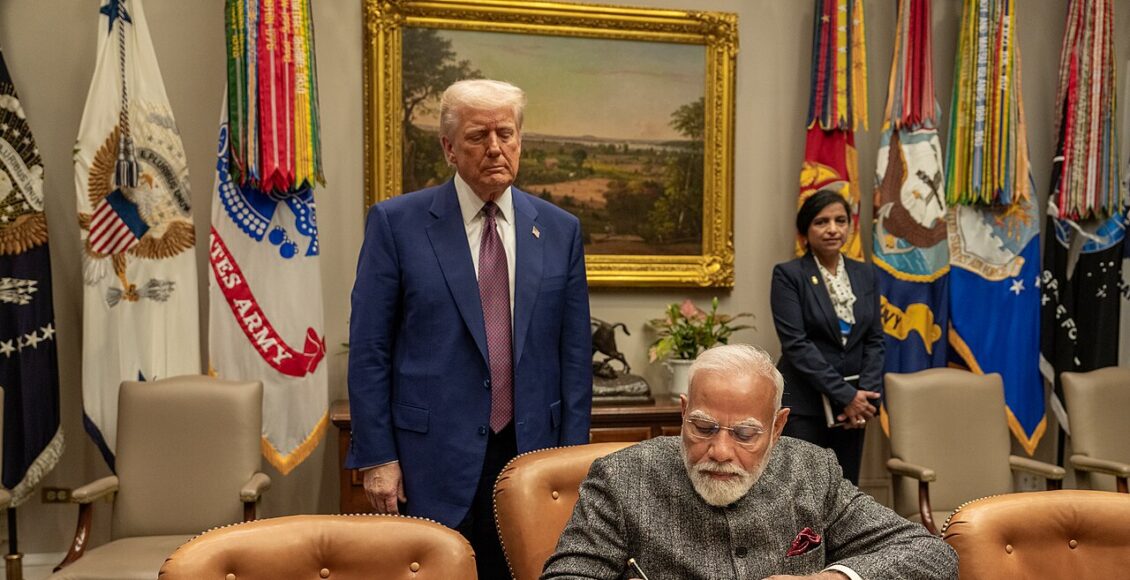
Featured Image: “President Donald J. Trump and Indian Prime Minister Narendra Modi (04)” by the White House is available in the Public Domain.

_and_INS_Vikramaditya_(R33)_with_the_carrier_battle_group.jpg)
.jpg)