
Opinion | Iran Beyond External Narratives
For 47 years, Iranians have waited to be heard. Instead, the Islamic Republic’s repressive regime has been met with the world’s complicit silence. Now, as war unfolds in the Middle East between the Islamic Republic, the United States, and Israel, a global outcry about the war has emerged, loud with opinion yet strikingly void at its core. The one voice that should matter most, the voice of ordinary Iranians themselves, is strikingly absent.
Iranians living under the Islamic Republic are not only subject to a repressive regime; they are now forced to endure the consequences of an undemocratic war with bombs falling over their heads and minimal protective infrastructure. Narratives imposed from abroad are far from reflective of their lived reality. Yet, rather than focusing on these lived realities, the global conversation has been transformed into an ideological battleground where outsiders compete to assert the “correct” stance on Iran.
In the process, Iranians are spoken over, their political agency denied, and their lived, nuanced experience reduced to a theoretical paradigm in someone else’s argument. A conversation that should begin with Iranians has instead been constructed around them, deliberately or not, leaving them unheard once again.
Legacy media and political commentators often distort and dismiss what Iranians are actually saying by privileging narratives that align with preconceived expectations while sidelining contradictory realities. For instance, outlets such as Al-Jazeera, funded by the Qatari government, have circulated images of Iranians mourning in the street following the death of Ali Khamenei, while downplaying and ignoring footage of celebrations elsewhere in the country. Furthermore, how reflective of reality are wartime government rallies in a state that has perpetuated propagandic images and ideology for more than four decades? Outside official imagery, Iranians with access to Starlink reported car horns and celebratory cries, expressing relief at the death of a figure many associate with decades of repression.
This pattern extends across the political spectrum, where both right- and left-wing commentators frame Iranian suffering through external ideological lenses rather than Iranian political agency. Conservative lobbyist Matt Schlapp said that the Iranian schoolgirls of Minab are better dead than in a burqa, insulting the victims of the tragic strike and their families. Such rhetoric frames civilian death as morally tolerable when it can be interpreted as collateral damage in a broader struggle against perceived religious extremism, turning victims into symbols within an ideological battle rather than individuals entitled to dignity and political agency. Across the political spectrum, activists such as Calla Walsh visited Iran on state-sponsored trips claiming that the crackdown on protestors was protecting the 1979 revolution from American- and Israeli-backed regime change. Both of these opinions, although politically opposite, are similar in that they use Iranians in an ideological battle. When Iranians express support or dissatisfaction for actions that weaken the regime, their views are not treated as political positions but pathologized as manipulation or desperation. This framing ignores the conditions that produced such anger and denies Iranians the agency to define their own reality.
At the same time, diaspora Iranians are routinely discredited as “disconnected” or “traitors,” and accused of warmongering or exaggerating repression. Social media influencers such as Ariana Jasmine have reinforced this framing by portraying diaspora activists’ support for strikes on Iranian military targets as equivalent to endorsing attacks on civilian infrastructure. This is both reductive and inaccurate. Diaspora communities remain deeply embedded in transnational networks of families and sources within Iran, often serving as essential sources of information during state-imposed blackouts. Their perspectives are grounded not in abstraction, but in continuous, firsthand accounts from those living under the Islamic Republic.
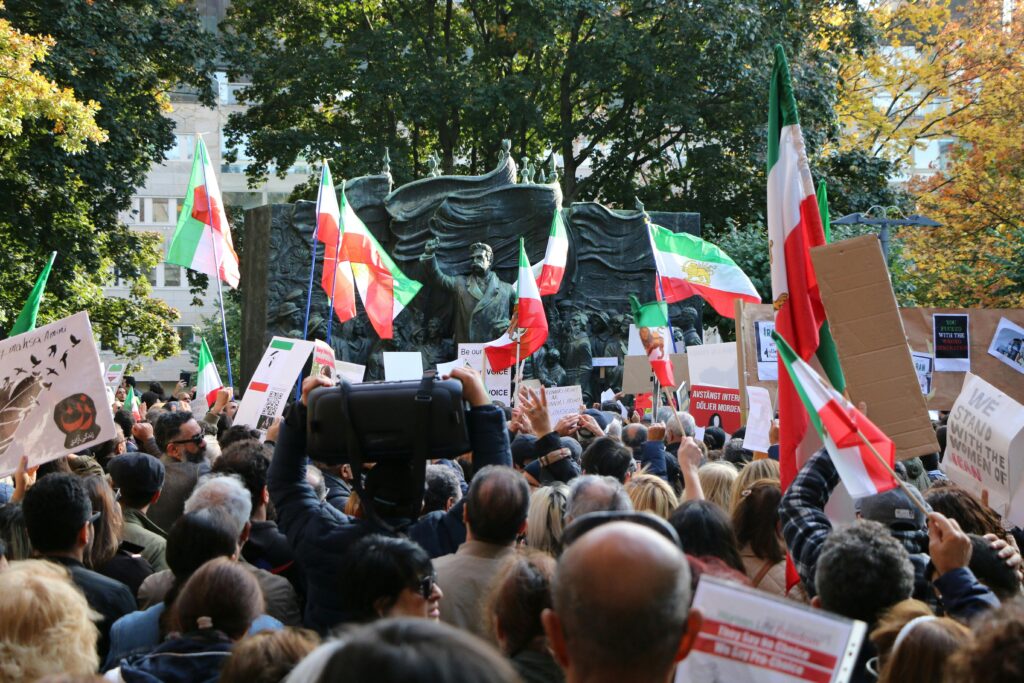
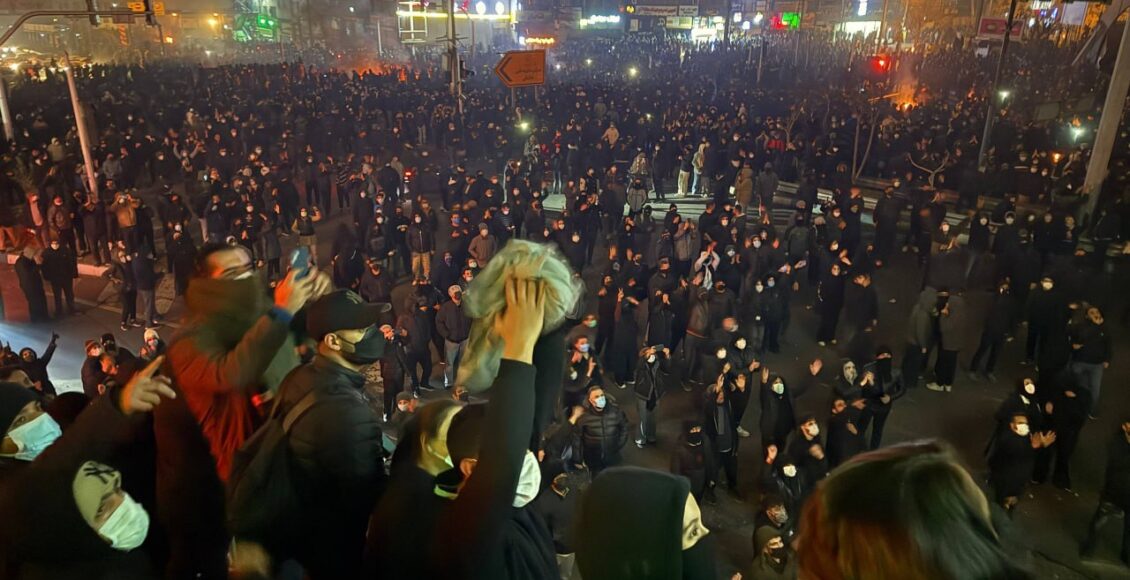
In the most recent wave of anti-government protestors beginning on January 7, demonstrations spread across more than 200 cities, reflecting a level of mobilization across social and economic classes. These protests were triggered by the continuous depreciation of the Iranian rial. In January, the rial fell to a historic low of 1.6 million rials per US dollar, rendering the currency worthless for imports and deepening hyperinflation. Decades of repression led to emboldened protestors who faced unprecedented violence inside the country. Human rights groups estimate more than 30,000 protestors were killed in the span of two days. This recent wave of unrest was met with dismissal and branded as instigated by “Zionists” or foreign agents, both by the regime and echoed within certain progressive anti-imperialist circles abroad, inferring that protests were a product of some external agenda rather than grassroots. These narratives do not simply misinterpret Iranian society—they erase its political agency. By reducing Iranians to passive subjects, these narratives obscure the courage of a population that has repeatedly risked everything, often bare-handed, to demand fundamental change reflected in protest chants invoking Crown Prince Reza Pahlavi. This momentum is further reinforced by a broad, cross-ideological coalition for change, encompassing figures such as Nobel laureate Shirin Ebadi alongside voices from both left- and right-leaning movements.
Since the protests and escalating conflict, discussions about Iran have increasingly been shaped by external ideological lenses rather than by lived realities inside the country. Interpreted through lenses like geopolitics, anti-imperialism, or broad anti-war activism, Iran is often reduced to a symbol rather than understood as a society with its own political demands. Similarly, anti-imperialist narratives centred on American foreign policy or oil politics recast Iran as an object of Western action, stripping Iranians of agency and reframing their struggle in external terms. This is especially evident in portrayals of the Islamic Republic as a force of resistance against the United States or Israel, which overlook its own record of regional intervention and repression. Most notably in Syria, Iran supported Bashar al-Assad’s regime by deploying IRGC forces and allied militias against civilians. In centring these external “theoretical” frames, such perspectives not only sideline Iranian voices but also those across the region who have suffered under the Islamic Republic.
Simplistic slogans such as “No War with Iran” exemplify this dynamic by ignoring the regime’s ongoing violence against its own population and its willingness to endanger civilians during moments of conflict. Amid widespread internet blackouts and the use of schools and universities to house military personnel, narratives that praise the Islamic Republic overlook a crucial reality: the regime has long waged war against its own citizens. By ignoring this, external activism not only oversimplifies the conflict but risks erasing the lived experiences of Iranians under theocratic rule. State-sanctioned violence in Iran has claimed an estimated 30,000 lives, while a single month of war resulted in 1,443 civilian deaths. Each of these lives carries equal weight, yet there is still a stark contradiction in how Western media groups and activists choose to ignore one over the other. Recently, in New York City, a vigil was held for Ali Khamenei, accompanied by chants which framed opposition to war and support for the Iranian state as ethical, while overlooking the regime’s direct responsibility for the deaths of thousands of Iranians. It is entirely possible to oppose war without aligning, implicitly or explicitly, with the very oppressor of the Iranian people.
Behind the headlines and the discourse lies a country of 90 million people who currently do not have access to the most basic means of expressing their suffering to the rest of the world. Amid war, the Islamic Republic executed a 19-year-old wrestler for his participation in anti-regime protests, after a trial marked by torture and lack of human rights. Behind every narrative is an Iranian forced to endure not only the threat of bombs, but a regime that neither protects them nor represents them.

One message, shared under immense risk, captures this reality: “With a thousand hardships, I managed to say that I am present in Tehran, and if I am killed, my killer is no one and nothing but the Islamic Republic.”
Yet, instead of listening, these voices are dismissed or labelled as warmongering or spoken over entirely. It leads one to question how privileged we must be to tell others what is best for their home country.
Edited by Jacob Van Bergh
Featured Image: A sea of protesters in Poonak, Tehran, on the second night of protests, January 8 2026. Photo by Vahid Online is licensed under CC BY 0.1.
