The Not-So-Marvellous City: Urban Spectacle and Gentrification in Rio de Janeiro

Rio de Janeiro’s Olympic Village has been completely abandoned.
Once-bustling athlete accommodations now stand largely vacant, some repurposed into luxury apartments while others have fallen into disrepair. The Olympic pool has been completely drained of all its water and sits empty with weeds beginning to sprout through cracks in the tiles. Seats from the Olympic stadium have lost their colour from years of neglect and exposure to the elements. And yet most of this will never be seen by the 6.8 million tourists that come to Rio de Janeiro every year, even though the Olympic Village lies just a stone’s throw away from the bright balneario beaches of Copacabana and Ipanema.
It’s a sight that many Cariocas know all too well in their hometown of Rio de Janeiro, a place they affectionately nickname “Cidade Maravilhosa,” the Marvellous City.
Since the start of the 21st century, Rio de Janeiro has hosted the Pan Am Games, the World Cup, the Olympic Games, and a G20 summit. For decades, Rio de Janeiro has served as Brazil’s showcase city of prosperity, the country’s medium for projecting its sophistication and modernity to the international stage. Thus, it has been paramount for the Brazilian government that Rio de Janeiro be equipped with all the infrastructure needed to rival other cities. But, over the years, it has become more and more apparent that urban spectacle is employed deliberately as a method to conceal the city’s poverty rather than to uplift Rio’s marginalized communities out of poverty.
In preparation for the 2016 Olympic Games, Rio de Janeiro underwent one of the largest infrastructure upgrades in its history, with an estimated total investment of $13 billion USD, focusing on public transport infrastructure and government housing projects in low-income favelas that would supposedly leave a lasting change for the better. However, due to budget mismanagement and locational discrimination, many of the services and infrastructure built for Rio before the Olympics became mostly out of reach for most citizens of the city.

The centrepiece of Rio’s Olympic investments, Metro Line 4, was a 16-kilometre extension connecting Ipanema to the Olympic Village. It was one of the most expensive infrastructure projects in Olympic history, going over its budget by more than 100 per cent. Opened on August 1, 2016, just days before the start of the Olympics, the majority of the new subway line ran through affluent, tourist-oriented neighbourhoods in Rio de Janeiro’s South Zone, including Ipanema, Leblon, and Barra da Tijuca, meaning that most commuters from poorer areas of the city were entirely unable to make use of the line. Instead, it primarily enhanced accessibility for wealthy residents and international visitors travelling between Rio’s upscale coastal districts and the Olympic venues. However, not only was the city blowing money it did not have on this elaborate metro line, but it was also actively hindering mobility across the city by rerouting numerous bus lines that had run between the poorer North and West Zones and the more affluent South Zone. Even though the city never provided an official justification for these cuts, the rationale behind the decision was quickly inferred by many. Afro-Brazilian communities, who predominantly live in the North and West Zones, were effectively excluded in a deliberate effort to limit the visibility of poorer populations in tourist areas during the international spotlight of the Games. Public transport remains one example of how Rio’s focus on urban spectacle perpetuates racist and elitist infrastructure, as many of the city’s poorer communities still rely on overcrowded buses or have no public transport service at all.
Another form of urban spectacle employed to portray Rio de Janeiro’s prosperity was the gentrification of the neighbourhoods surrounding the Olympic Village in Barra da Tijuca. Comprising 31 apartment towers and over 3,600 apartments, the Village was constructed at a cost of $1.65 billion USD. However, to acquire the land required for such development, many residents who lived in close proximity to the planned Olympic Village faced forced eviction orders to make way for construction, particularly near key athletic complexes.
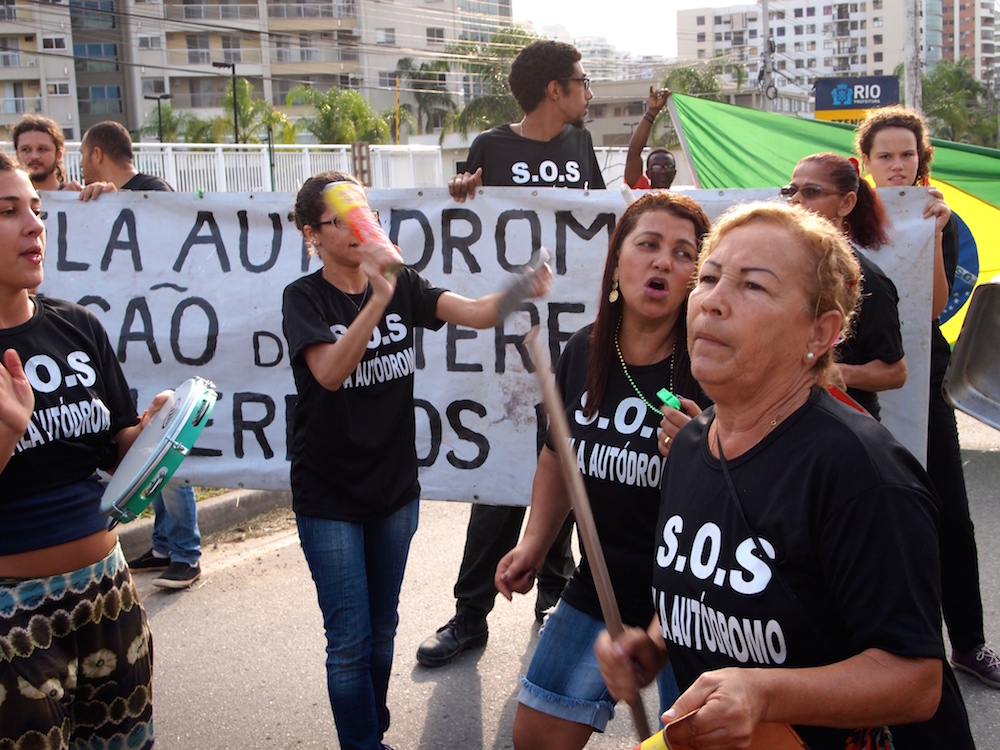
Even though the majority of residents complied with the municipal government’s order, one such settlement that fought back against Rio de Janeiro’s efforts was Vila Autodromo, a small, low-income but tight-knit community of 1,000 people directly west of where the Olympic Village was slated to be built. Instead of directly complying with the municipal government’s orders, the community decided to stay, forcing the government to evict them by military force. For many of the residents of Vila Autodromo, it felt like a horrible betrayal:
“I received nothing. Nothing. I am here only with my face, courage, and bones, to fight for a home inside my community.” — Maria da Penha, resident of Vila Autodromo, commenting on the eviction order.
“Vila Autódromo vai ficar!” (Vila Autodromo will stay!) — Chant used by residents to protest the government of Rio.

When military coercion failed, Rio begrudgingly allowed them to stay, but on the condition that the municipal government would build them nicer, more presentable housing, for fear that the international audience would catch a real glimpse of what true everyday life looks like in Rio de Janeiro.
In recent years, the rise of social media and influencers has only exacerbated the plight of most residents of Rio de Janeiro. The city has long been glamorized in global media, tourism campaigns, and influencer culture as the quintessential Brazilian city: a city bathed in sunshine, samba, Carnaval, and breathtaking natural beauty. Brazil evidently has reason to maintain such a portrayal of Rio, as the glamorized image of the city draws millions of international tourists each year. Tourism is an important sector of the Brazilian economy, contributing over $1 billion USD to the country’s GDP and accounting for around 8 per cent of the country’s GDP. Thus, the government has a strong incentive to emphasize leisure and beauty through urban spectacle while downplaying the city’s social and economic realities.
And it seems to be working. People keep coming to Rio de Janeiro, and the city was recently the host of a G20 summit, once again drawing international attention, fame, and the spotlight. But, insofar as the international audience remains unaware of the poverty most residents of the city live in, the Brazilian government sees no incentive to change the status quo. The most affluent regions of the city will continue to receive the lion’s share of investment, while many favelas and marginalized neighbourhoods will continue to remain neglected or subject to forced evictions as areas continue to gentrify.
Perhaps the Marvellous City isn’t so marvellous after all.
Edited by Idan Miller
Featured Image: Photo by Alexander Ruiz is licensed under the Unsplash License.