
The Real Inheritance: The Shadow Economy Fuelling North Korea’s Dynasty
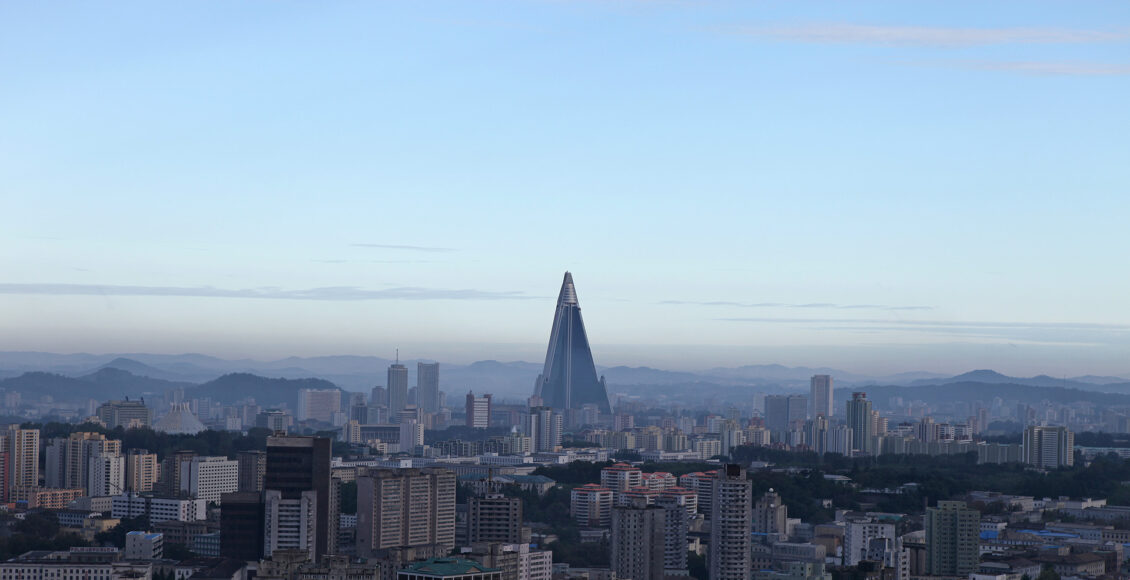
In February 2026, South Korea’s National Intelligence Service (NIS) informed legislators in Seoul that Kim Jong Un is preparing to designate his daughter, Kim Ju Ae, as his successor—entering what the NIS called the “succession selection stage.” Coverage of the announcement focused on nuclear arsenals and UN leverage, the familiar framing of North Korea analysis. Yet Ju Ae’s inheritance is not just geopolitical assets. It is a criminal empire—a shadow economy the Kim family has deliberately cultivated across three generations to keep power firmly within the dynasty.
To fully understand the economy Kim Ju Ae will inherit, one must understand the contradictory relationship between the bottom-up black market—known as jangmadang—and the top-down criminal enterprise—two illegal economies that, despite working against each other, are locked in an uneasy equilibrium.
In the mid-1990s, several decades of failed economic policies, chronic food shortages, and unsound agricultural practices coalesced into a famine, dubbed the “Arduous March,” that killed an estimated 600,000 to one million—roughly three to five per cent of the North Korean population. The famine was the culmination of a long-deteriorating food crisis. The state’s Public Distribution System, through which the regime had rationed food and loyalty since the Korean War, operated through yanggwon—ration coupons distributed every fifteen days that could be redeemed at state stores for grain. By the early 1990s, however, allocations had fallen so far that the country was producing enough to cover only 60 per cent of its food needs, with the remainder consisting largely of corn rather than the rice the state had long promised.
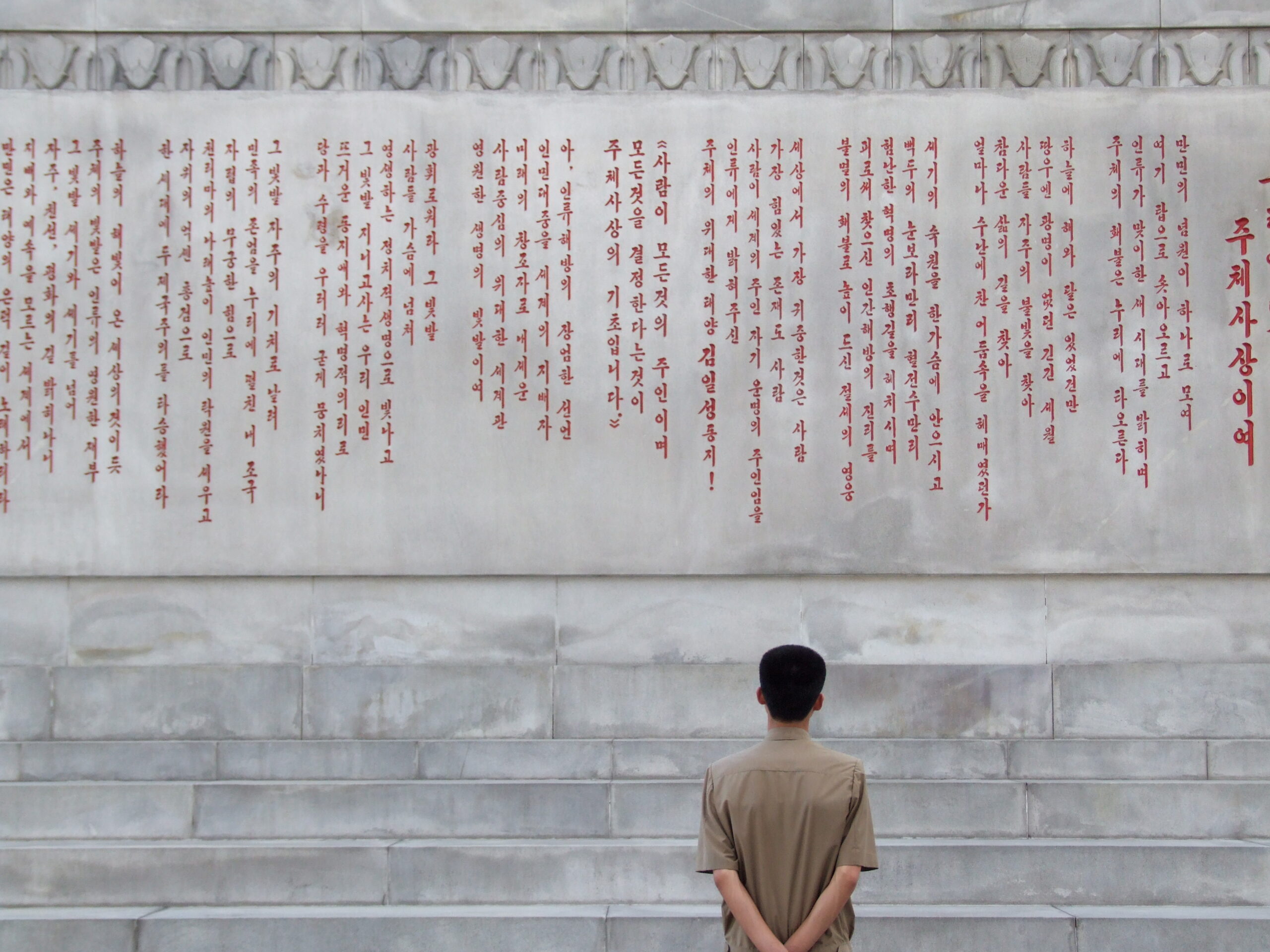
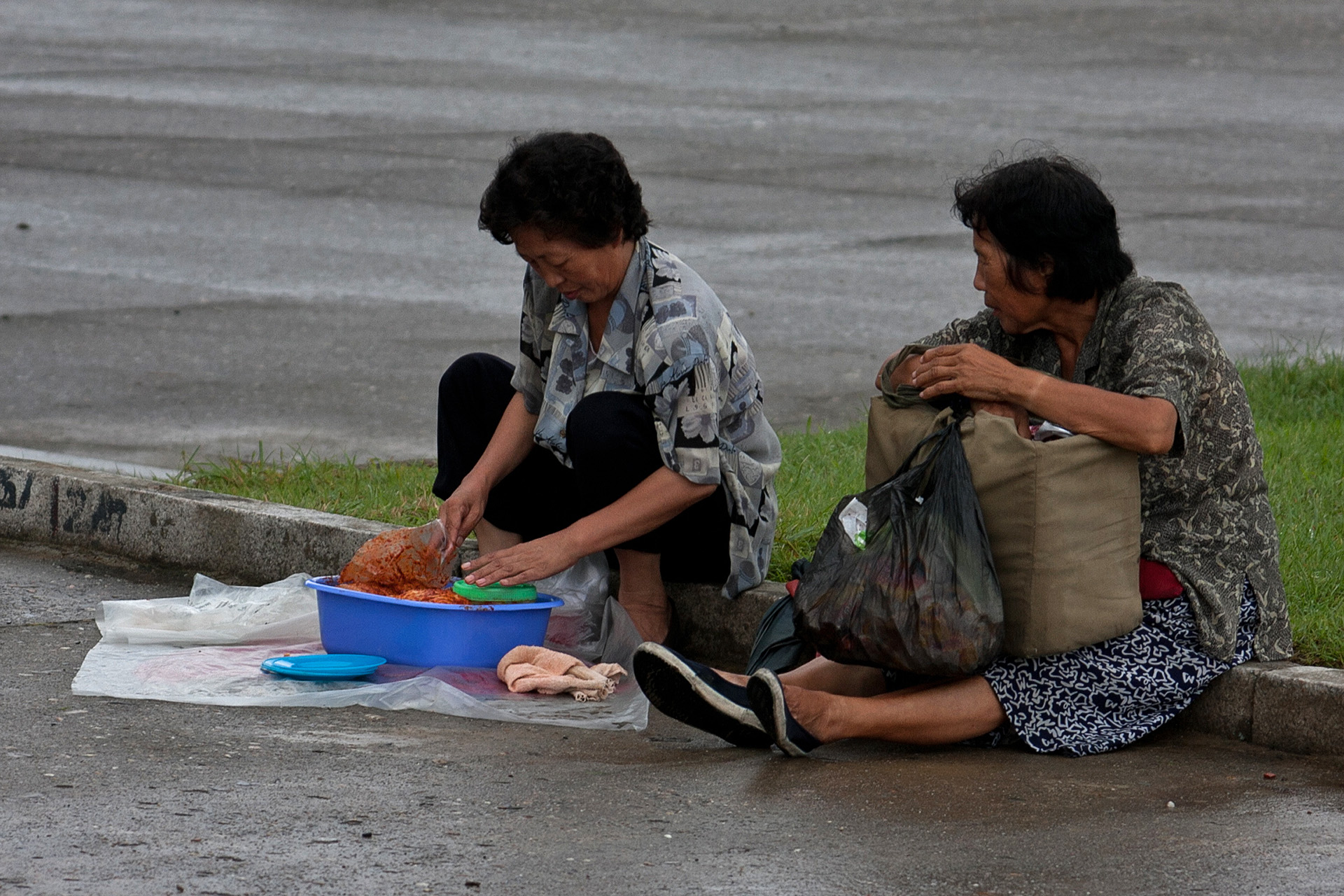
The system, already failing before the catastrophic floods of 1995 and the withdrawal of Soviet subsidies, delivered the final blows, leaving an entire population dependent on a government that could no longer feed them. The state did not feed its people. So it’s people fed themselves—and in doing so, enacted a grassroots version of the very philosophy the regime had long preached. The North Korean state had promoted juche—the national ideology of self-reliance—as an expression of ideological strength and creativity. In practice, it had become a survival instinct: a framework that justified whatever improvisation was necessary to stay alive. Nowhere was this more visible than in the jangmadang.The jangmadang—informal black markets that had existed on the margins of the planned economy—exploded in scale and reach after the “Arduous March,” filling the void the state had left behind. Though classified as illegal by the state, what keeps them alive is, ironically, the complicity of the very officials tasked with shutting them down. Local officials extorted vendors rather than arresting them, collecting irregular payments in exchange for looking the other way to subsidize their already meagre government wages.
The regime, which depends on socialist ideology for its legitimacy, viewed the markets as a direct threat—Kim Jong-il himself called them “a birthplace of all sorts of non-socialist practices.” Then, in 2009, the regime announced an abrupt currency redenomination, wiping out private savings overnight and destroying whatever trust remained in the North Korean won. The move backfired catastrophically. The US dollar and Chinese yuan became the de facto currencies of daily commerce, further loosening the state’s grip on the economy. Yet over the past two decades, regime response has oscillated between grudging tolerance and crackdowns. The markets are here to stay, with over 400 now officially sanctioned by the government, and the regime leverages taxes and fees on merchants to generate revenue, cynically benefiting from the population’s contentment. A generation has now come of age in North Korea with no memory of state distribution, no economic logic other than the market, and little regard for a regime they see as an obstacle to their own prosperity.
Yet while ordinary North Koreans were building a shadow economy from the bottom up, the Kim family was constructing one from the top down—and with considerably more resources. Juche, the same philosophy of self-reliance that drove ordinary North Koreans to the jangmadang, provided ideological cover for the regime’s own improvisation—whatever it took to keep the dynasty in power.
At the state level, the regime runs a very different and far more sophisticated illegal economy, in what is essentially a sovereign criminal enterprise. With the North Korean won worthless outside its borders, international sanctions cutting off legitimate revenue, and Soviet subsidies long gone, hard currency became the regime’s most critical resource—and obtaining it by any means necessary became state policy.
Bureau 39, a Workers’ Party body whose primary function is generating hard currency for the Kim family, coordinates drug trafficking, arms sales to sanctioned regimes, counterfeiting, and the smuggling of resources past UN Security Council resolutions. North Korean state-produced methamphetamine was distributed across East and Southeast Asia through Chinese criminal networks for over a decade before the program was scaled back in the mid-2000s. North Korea has also been shown to have ties to the Golden Triangle, Southeast Asia’s opium- and heroin-production zone in Myanmar, Thailand, and Laos. In addition to drug trafficking, counterfeiting operations produced convincing USD “supernotes” that circulated for decades.
However, the most sophisticated pillar of the state’s illicit economy is cyber operations.
The Lazarus Group, a state-directed hacking collective, has become the regime’s most productive source of revenue. In 2025, North Korean hackers stole over $2 billion USD in cryptocurrency—a 51 per cent increase over the prior year—pushing their confirmed cumulative total to $6.75 billion USD. Cyber theft in itself provides an estimated 50 per cent of Pyongyang’s foreign currency revenue and is the primary funding source for its weapons programs.
What makes this criminal enterprise remarkable is not just its scale, but the contradiction it reveals. The regime’s machine runs on secrecy and centralized control—yet the jangmadang represent the opposite: decentralized, bottom-up erosion of that control. Kim Jong Un has responded by attempting to crush the latter while expanding the former, but the bribery ecosystem keeping the markets alive has become so endemic that it functions as an informal tax system, one that the regime cannot dismantle without destabilizing the officials it depends on. These are two illegal economies in direct tension—and it is this tension that defines what Kim Ju Ae will inherit.
What Kim Jong Un inherited from his father, Kim Jong-il, was a regime in managed decay: a criminal apparatus still functional but increasingly exposed; a population whose loyalty had been replaced by market logic; and an authority increasingly delegated by elite factions. Where Jong-il had distributed power among a broader circle of elites, Jong Un’s response was one of consolidation: purges of the old guard in favour of loyalists, centralization of ideological control, and an emphasis on cyber warfare as a primary illicit strategy. But consolidation came with a trade-off. While Jong Un opened up the economy and decreased major crackdowns on traders’ markets, corrupt practices were normalized, and surveillance expanded across every layer of society. Ju Ae will inherit a more stable but brittle version of that same machine—one her father hardened but did not fundamentally resolve.
A stable succession requires more than consolidating control over Bureau 39 or cracking down on the markets. It requires finding the middle ground between a centralized criminal enterprise that funds dynastic rule and a decentralized market economy on which the population now depends for survival—and, in doing so, legitimizing her rule. That equilibrium has never been formalized—it has simply been tolerated, maintained through bribery and selective repression. For Ju Ae, tolerating it will not be enough. Without a deliberate accommodation of the jangmadang generation’s economic interests and the hard-currency demands of the state apparatus, legitimacy will remain perpetually out of reach.
On a geopolitical level, North Korean analysis focuses on a nuclear-armed state and the military threat it poses to the region. But a fuller picture requires understanding the illicit economy that funds those military capabilities and sustains the regime’s grip on power—because it is that economy, not the arsenal, that Kim Ju Ae will ultimately depend on to rule. The real inheritance is not a throne. It is a balancing act with no margin for error.
Edited By Shumyle Eman Shahid
Featured Image: Photo by Roman Harak is licensed under Creative Commons.


.jpg)
.jpg)